

Q: What is peptide therapy?
A: “Peptide therapy” is an umbrella phrase, not one specific treatment. It can describe an FDA-approved peptide medicine, an investigational product being tested in trials, a compounded prescription made by a pharmacy, or a product with no clear regulatory record at all. To know what you are actually being offered, you need the exact molecule, the product, the intended use and its current U.S. status.
Informed choice starts with knowing what you are choosing. That sounds obvious, yet one of the fastest growing phrases in wellness marketing is so broad that two people using it can mean completely different things. “Peptide therapy” shows up on clinic websites, in social media ads, on telehealth platforms and in conversations at the gym. Sometimes it refers to a well studied prescription medicine. Sometimes it refers to something that has never been tested in people.
People who value making their own health decisions have the most to gain from clarity here. You cannot weigh benefits and risks for yourself if the label hides what the product is. This guide explains what peptide therapy can mean, how the four main categories differ, what questions to ask any provider, and where to check the answers yourself using public records.
What Is Peptide Therapy, Really?
Peptides are short chains of amino acids. Many of the body’s natural messengers are peptides, and a number of approved medicines are peptides too. So at the most basic level, peptide therapy means using a peptide as a treatment.
The trouble is that the phrase stops there. It does not tell you which peptide, made by whom, tested for what, or given in what form. The Peptides Blog puts it well in its guide to what the phrase “peptide therapy” actually covers: the term is an umbrella over several kinds of products, and each kind comes with its own type of record and its own limits on what the evidence can show.
Even the definition of a peptide is not fixed across every context. In FDA’s 2023 draft guidance on clinical pharmacology for peptide drugs, the agency defines a peptide for the purpose of that document as a polymer of 40 or fewer amino acids. That is a working definition for drug developers, not a consumer category, and it does not create any official treatment type called peptide therapy.
The Four Things “Peptide Therapy” Can Mean
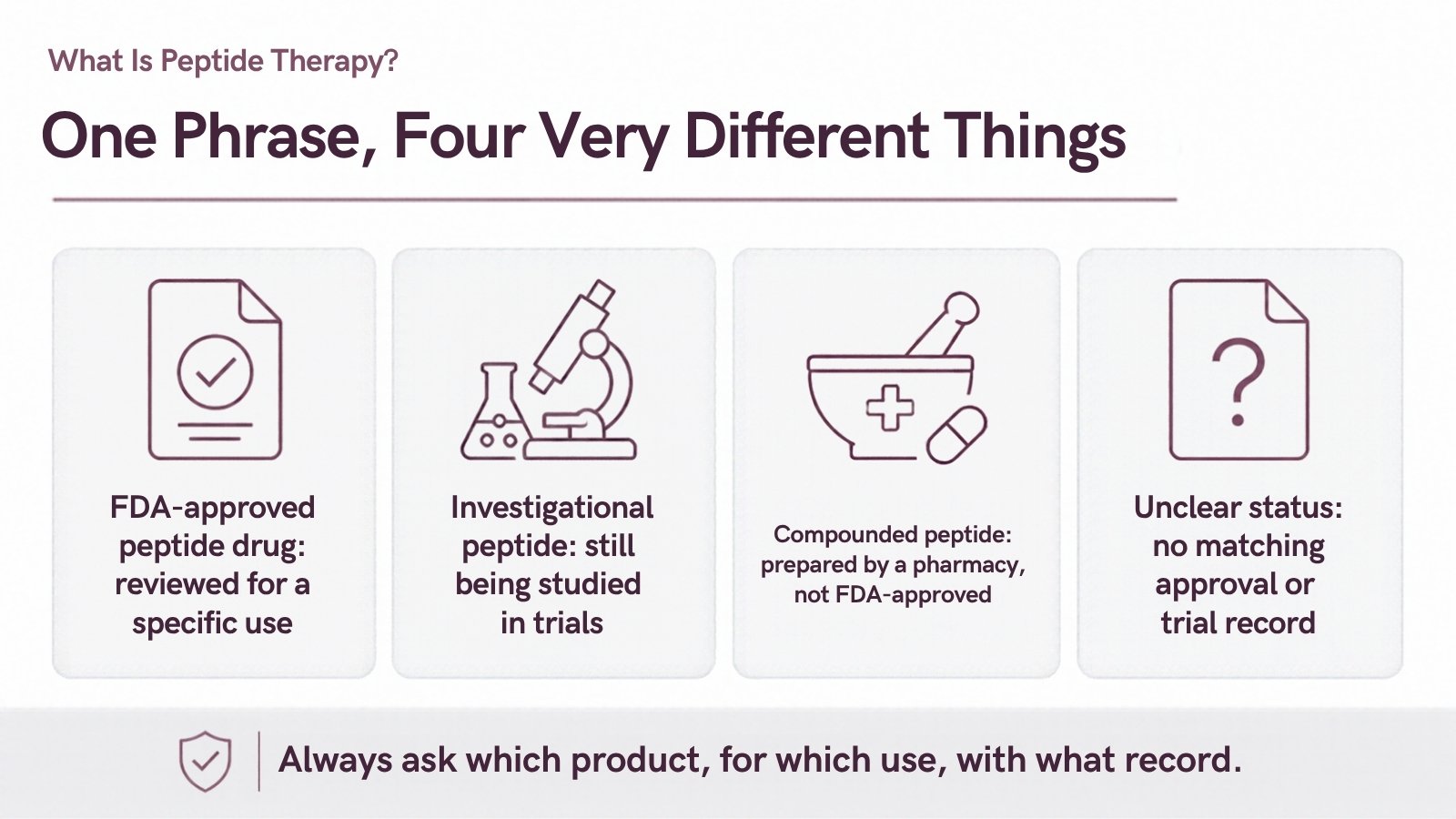
1. An FDA-approved peptide medicine
Several prescription medicines in wide use are peptides or peptide-based. Insulin products are a long standing example. More recently, GLP-1 based medicines such as semaglutide and tirzepatide have become some of the most discussed drugs in the country. When FDA approves a medicine, it approves a specific product for a specific intended use. According to FDA’s own approved drugs questions and answers page, reviewers examine the sponsor’s testing data, manufacturing information and proposed labeling, and approval follows a determination that the product’s benefits outweigh its known and potential risks for the approved use.
Two details matter for patients. First, approval belongs to the reviewed product, not to every product with a similar ingredient name. Second, a licensed prescriber may use an approved drug off-label, meaning for a use that is not on the label. That can be legitimate medical practice, but the off-label use itself has not been approved. “FDA-approved peptide therapy” is only fully accurate when the product and the use both match the approved labeling.
2. An investigational peptide
Many peptides are being studied in clinical trials. An investigational product is one that researchers are still testing to learn whether it works and is safe enough for a particular condition. FDA’s consumer explainer on the terms it uses for possible new therapies separates investigational use from approval and describes expanded access, which can allow a patient with a serious or life-threatening condition to receive an investigational product when no comparable or satisfactory therapy is available and regulatory requirements are met.
A trial being listed does not mean the trial is finished, that results are posted, or that the product worked. It means research is planned or underway. Laboratory and animal results may justify human studies, but they do not show what will happen in people.
3. A compounded peptide
Compounding is when a licensed pharmacist or physician combines or alters ingredients to create a medicine tailored to a patient’s need. FDA’s compounding questions and answers give examples such as removing a dye for a patient with an allergy or making a liquid version for someone who cannot swallow a tablet. Compounding can fill real gaps, including during certain drug shortages.
The key fact for patients is that FDA does not approve compounded drugs and does not verify their safety, effectiveness or quality before they are marketed. State boards of pharmacy oversee most compounding pharmacies, while registered outsourcing facilities fall under closer FDA oversight and must follow current good manufacturing practice. FDA warns that poor compounding practices can lead to contamination or the wrong amount of active ingredient. A compounded product is not the same as the approved product it may resemble.
4. A product with unclear status
The fourth category is the one to approach most carefully. Some websites and sellers use peptide therapy language, or describe products as “for research,” without naming a product that matches any approval, trial or compounding record. In these cases you have no public evidence about what is in the vial, how it was made or whether it does anything in humans. The word research on a label does not mean a clinical trial studied that product.
The Peptides Blog goes deeper into these distinctions in its comparison of approved, investigational, compounded and research-only peptides, which is worth reading before any clinic consultation.
Comparing the Categories Side by Side
| Category | Who reviews it | Public record to check | What the label can tell you |
|---|---|---|---|
| FDA-approved drug | FDA, before marketing | Drugs@FDA and current prescribing label | Approved uses, dosing, warnings, side effects |
| Investigational product | FDA and ethics boards oversee the research | Trial registry entry and any posted results | What is being studied, not whether it works |
| Compounded drug | Not FDA-approved; state boards oversee most pharmacies | Pharmacy and prescriber documentation | Ingredients and strength as prepared, without FDA review |
| Unclear status | No identifiable reviewer | None that matches the product | Very little you can independently verify |
How Medicines Move From Idea to Approval
Understanding the normal path a medicine takes helps explain why the categories above matter. In this short video, FDA’s Center for Drug Evaluation and Research walks through the steps from early research to clinical trials to agency review:
The point is not that every approved drug is right for every person, or that everything outside the approval pathway is useless. The point is that each category comes with a different amount of independent checking. Knowing which one you are dealing with lets you decide how much uncertainty you are willing to accept.
Why the Vague Label Is a Problem for Patient Choice
Respect for patient choice depends on informed consent, and informed consent depends on accurate information. Our earlier piece on why medical decision-making matters to patients makes the case that people deserve to understand their options fully. A broad marketing term can quietly undermine that.
Consider how the same sentence can mislead in different ways. “Our peptide therapy is backed by clinical research” might be true of an approved medicine used for its labeled purpose. It might also be technically true of a compounded product that shares an ingredient with a drug that was studied, even though the compounded version itself was never tested. Or it might refer to animal studies on a molecule that has no human trial data. Each version supports a very different level of confidence, and the sentence alone does not tell you which one applies.
Pricing and payment can add pressure. Many clinic programs are cash pay and packaged as memberships. Asking for specifics before you sign up is not being difficult; it is the minimum needed to make a real choice.
Five Details That Turn a Vague Claim Into a Checkable One
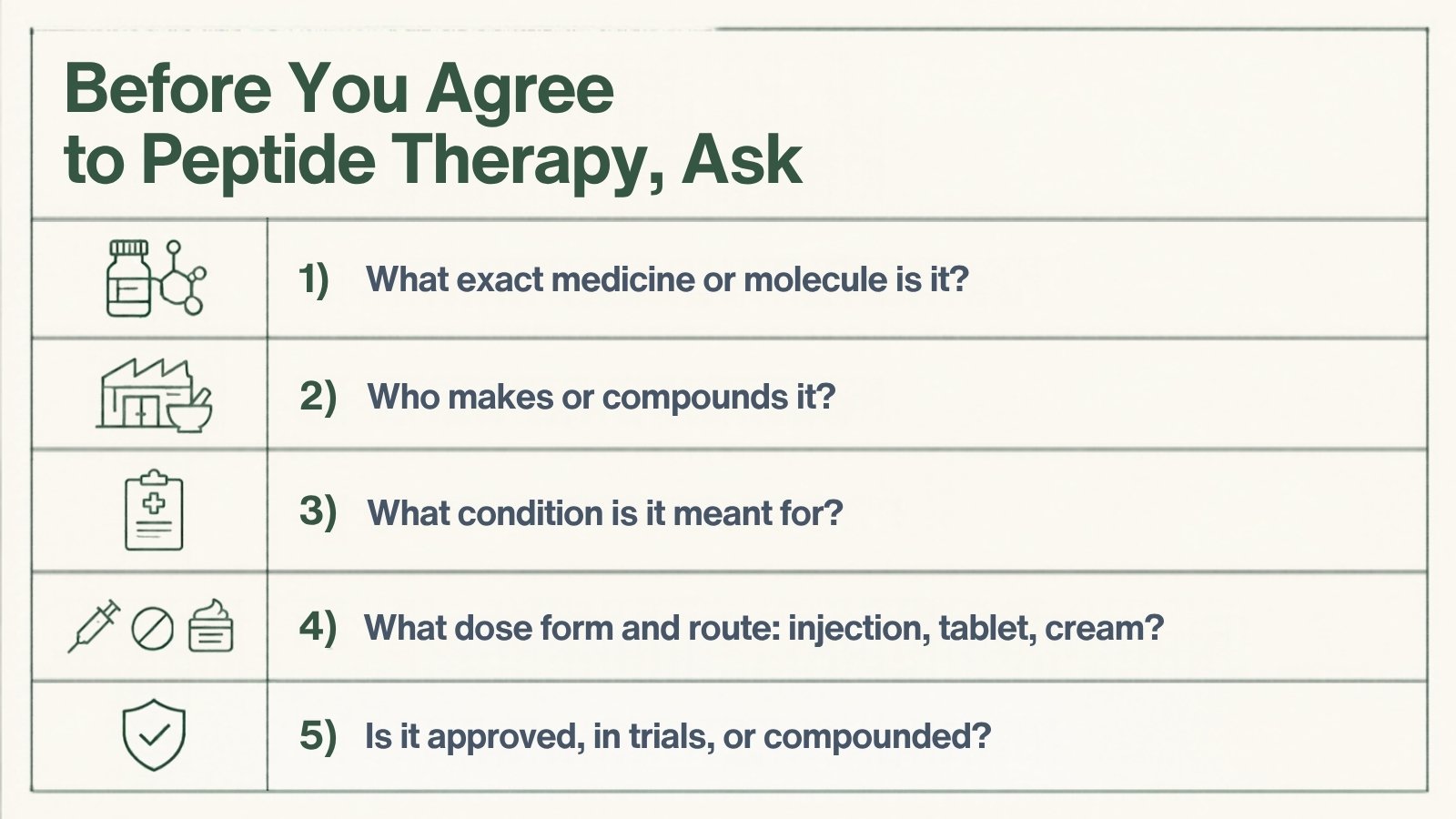
The exact molecule. Get the active ingredient’s name as it appears on the label or prescription. “A peptide” or “a peptide stack” is not enough.
The exact product and maker. Who manufactured it, or which pharmacy compounded it? Two products with the same ingredient can differ in purity, strength and quality controls.
The intended use. What condition or goal is this for, and for whom? Compare that with the approved label or the trial’s stated purpose. Approval for one use does not extend to others.
The formulation and route. Injection, tablet, nasal spray and cream can deliver very different amounts of the same molecule. Evidence from one form does not automatically apply to another.
The current status. Is it an approved product used as labeled, an approved product used off-label, an investigational product, a compounded preparation, or unclear? Ask the provider to state it plainly and in writing.
How to Check the Answers Yourself
You do not need to take anyone’s word for it. Public records exist for most of these questions.
For approval claims, search FDA’s Drugs@FDA database for the exact product or active ingredient, then read the current prescribing information. Compare the approved uses with what you are being told.
For research claims, look the product up on ClinicalTrials.gov, the U.S. National Library of Medicine’s trial registry. Check the study status, the exact intervention, the condition being studied and whether results have been posted. The Peptides Blog has a practical walkthrough on checking a peptide’s trial record step by step.
For compounded products, ask for the name of the compounding pharmacy and whether it is a state-licensed pharmacy or a registered outsourcing facility. Your state board of pharmacy can confirm a pharmacy’s license status.
For anything else, if a seller cannot connect the product to any of these records, treat its status as unclear and weigh that accordingly.
A Note on State Policy and Access
Rules on compounding, telehealth prescribing and clinic advertising are shaped at both the federal and state level, and they change. Idaho residents following these issues can find context on recent developments in our roundup of Idaho healthcare policy updates for medical rights advocates. Whatever the policy climate, the patient’s best protection is the same: precise information about the exact product being offered.
Common Myths About Peptide Therapy
“Peptides are natural, so peptide therapy is safe.” Many peptides do occur naturally, but a manufactured product’s safety depends on the specific molecule, dose, purity and route. Natural origin is not a safety guarantee.
“If one peptide is FDA-approved, peptides in general are approved.” Approval is product-specific and use-specific. It does not transfer to other molecules or to other products with similar ingredients.
“Compounded means the same as generic.” Generic drugs go through FDA review and must meet equivalence requirements. Compounded drugs do not receive FDA approval.
“Research use only means it has been researched in people.” That phrase usually signals the opposite: the seller is not presenting it as a product for human use, and there may be no human trial data.
“A trial listing proves it works.” A registry entry shows what researchers planned. Only results from completed studies can speak to outcomes, and only for the product and population studied.
Why Formulation and Route Change the Picture
One reason peptide therapy is so easy to oversell is that peptides behave very differently depending on how they are delivered. Many peptides are broken down by digestive enzymes, which is why a large share of peptide medicines are given by injection. Developers who want an oral version often have to modify the molecule or add special ingredients to help it survive the gut and be absorbed. Creams face a different barrier, because skin is designed to keep molecules out.
So when a product claims the same benefits as a studied injectable medicine but comes as a capsule, a spray or a topical, ask what evidence exists for that exact form. Results from one route cannot simply be assumed for another.
Weighing It All Up
Peptide medicines are a real and important part of modern medicine, and research into new peptides is active. None of that is in question. What is in question is whether any particular product sold under the peptide therapy banner has the evidence and oversight its marketing implies. The only way to know is to pin down exactly what it is.
Bring your questions to a licensed clinician who knows your health history, ask for the specifics in writing, and check them against the public records described above. That approach respects your right to choose while making sure the choice is grounded in fact.
For clear, sourced explanations of peptide science and the clinical studies behind peptide medicines, explore peptide benefits and the research behind them at The Peptides Blog’s independent research library. It is an educational publication that links to original sources and does not sell peptides, provide treatment or offer medical consultations.
What an Approved Peptide Medicine Looks Like in Practice
It can help to picture the difference concretely. When a clinician prescribes an approved peptide medicine for its labeled use, several things normally happen. The prescription names a specific branded or generic product. It is filled by a licensed pharmacy from manufacturer stock. The package comes with prescribing information and a patient leaflet that describe the approved uses, the dosing schedule, known side effects, warnings and situations where the medicine should not be used. Your prescriber typically reviews your history and other medicines, and may order follow-up checks depending on the drug.
That paper trail is not a guarantee that a medicine will suit you, and approved medicines still carry risks. But it means there is a public, checkable body of information about the product, and someone is accountable for each step. When a peptide offering lacks most of these features, that is not automatically proof of a problem, but it does mean you are carrying more of the uncertainty yourself.
Red Flags in Peptide Therapy Marketing
Some patterns show up again and again in promotional material. None of them proves a product is unsafe, but each is a good reason to slow down and ask more questions.
No molecule named. Phrases like “our proprietary peptide protocol” or “custom peptide stack” without specific ingredient names make independent checking impossible.
Approval borrowed from another product. Pointing to an approved medicine to vouch for a compounded or unlisted product that merely shares an ingredient.
Animal results presented as human outcomes. Statements about healing, recovery or longevity drawn from rodent or cell studies, with no mention that human trials are missing.
One product for many unrelated problems. A single peptide promoted for joints, skin, sleep, weight, mood and energy all at once is a sign that marketing has outrun evidence.
“Research use only” next to dosing instructions. If a seller labels a product as not for human use but then explains how to inject it, the contradiction speaks for itself.
Pressure to commit quickly. Limited-time membership offers or bundled multi-month packages can discourage the questions you are entitled to ask.
A Simple Script for Your Next Appointment
Many people find it awkward to question a provider directly. Having the words ready helps. You might say something like this: “Before I decide, could you write down the exact name of the medicine, who makes it or which pharmacy prepares it, what it is meant to treat in my case, how it is given, and whether it is FDA-approved for that use, being studied in trials, or compounded?” Follow up with: “What side effects or risks should I watch for, and what monitoring would you do?”
A good clinician will welcome those questions, because they are exactly the questions informed consent depends on. If the answers are vague, evasive or delivered with pressure, that tells you something important too. You can always take the written answers home, check them against the public records described above, and come back once you are comfortable.
Frequently Asked Questions
What is peptide therapy in simple terms?
It is a broad phrase for using peptides, short chains of amino acids, as treatments. Depending on who is using it, it can mean an FDA-approved medicine, an investigational product, a compounded prescription or a product with no clear regulatory status.
Is peptide therapy FDA-approved?
Some peptide medicines are FDA-approved for specific uses. “Peptide therapy” as a general category is not. Approval applies to a particular product for a particular use, so you need to know exactly which product is being offered and why.
Are compounded peptides the same as approved drugs?
No. FDA does not approve compounded drugs or verify their safety, effectiveness or quality before they are sold. A compounded product may share an active ingredient with an approved drug but is a different product.
How can I tell if a peptide is being studied in clinical trials?
Search the exact name on ClinicalTrials.gov. Review the study status, the exact intervention and condition, and whether results have been posted. A listing alone does not show that the product works.
What questions should I ask a clinic offering peptide therapy?
Ask for the exact molecule, the manufacturer or compounding pharmacy, the intended use, the dose form and route, and the product’s current regulatory status. Request the answers in writing.
Can a doctor prescribe an approved peptide medicine off-label?
Yes, licensed prescribers can use an approved medicine for an unapproved use when they judge it appropriate, subject to applicable rules. The product remains approved, but the off-label use itself has not been reviewed and approved by FDA, so it is worth asking what evidence supports that specific use.
Disclaimer
This article provides general educational information about how peptide products are categorized and regulated. It is not medical or legal advice and does not recommend any product, clinic or treatment. Nothing here should be used to diagnose, treat or prevent any condition.
Prescription medicines should only be used under the care of a licensed clinician. Regulatory status can change, so verify current information with official sources. Laws on compounding, telehealth and prescribing vary by state and country. Consult a qualified healthcare professional about your own situation.